| Availability: | |
|---|---|
| Quantity: | |
ZW32
DGG
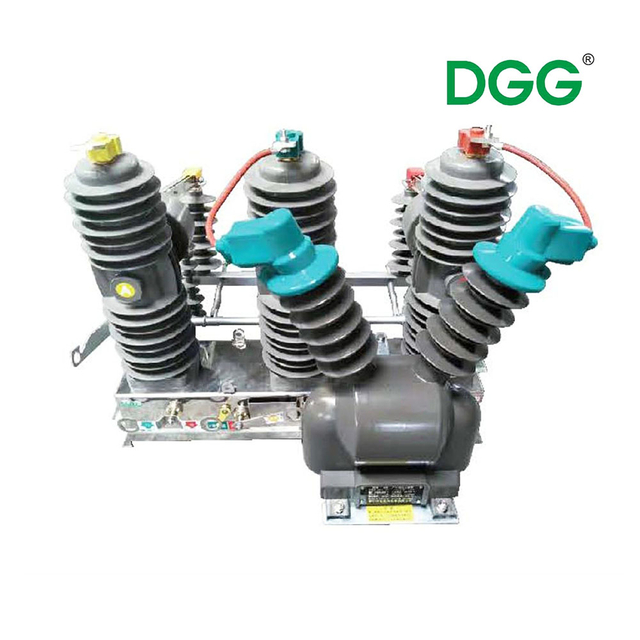
The deeply integrated primary and secondary pole-mounted circuit breaker is an intelligent outdoor switching device developed for modern distribution automation systems.
Unlike a conventional pole-mounted circuit breaker that mainly performs circuit switching and fault interruption, the integrated solution combines primary electrical equipment with secondary sensing, protection, monitoring and communication functions.
Depending on the project configuration, the system can collect current and voltage information, monitor breaker operating status, identify feeder faults, execute opening and closing commands, and communicate operating data with the distribution automation system.
The integrated architecture reduces the number of separately installed components and simplifies the connection between primary and secondary equipment. It is particularly suitable for overhead distribution lines, feeder automation projects and smart distribution network upgrading.
DGG's ZW32 intelligent recloser platform supports functions including control, protection, measurement, communication, fault detection and online monitoring of opening and closing status, providing a technical basis for intelligent distribution applications.
Key Functions
Switching and Fault Interruption
The vacuum circuit breaker performs normal circuit opening and closing operations and can interrupt overload and short-circuit fault currents together with the protection system.
Electrical Measurement
Current and voltage information can be collected for feeder monitoring, protection and distribution network operation.
Protection
The integrated protection system can respond to abnormal operating conditions and provide protection logic for distribution feeders.
Fault Detection
Operating data can be used for feeder fault detection and support fault section identification and isolation.
Remote Monitoring
Breaker operating status and electrical information can be monitored through the matched intelligent controller and distribution automation system.
Remote Control
The circuit breaker can support remote opening and closing operations when configured with the appropriate controller and communication interface.
Automatic Reclosing
According to the protection and control configuration, automatic reclosing can be implemented to support feeder fault handling and power restoration.
Key Features
Primary and Secondary Integration
Combines primary switching equipment with secondary measurement, protection, monitoring and communication functions.
Designed for Distribution Automation
Suitable for feeder automation and smart distribution network applications.
Vacuum Interruption Technology
Uses vacuum interruption for circuit switching and fault current interruption.
Integrated Three-Phase Structure
Compact three-phase configuration helps simplify pole-mounted equipment arrangement.
Remote Operation Capability
Can work with an intelligent controller for remote opening, closing and system monitoring.
Fault Detection Support
Provides operating information required for feeder fault identification and isolation.
Automatic Reclosing Capability
Supports automatic reclosing according to the selected protection and control scheme.
Project-Based Configuration
Measurement, protection, controller and communication functions can be configured according to utility or EPC project requirements.
During normal operation, the pole-mounted vacuum circuit breaker controls the connection and disconnection of the distribution feeder.
When abnormal current or a system fault is detected, the secondary protection and control system processes the corresponding electrical signals and issues a trip command according to the configured protection logic. The operating mechanism drives the vacuum interrupter to open the circuit and isolate the fault.
After the fault condition is evaluated, the controller can perform reclosing operations according to the preset protection strategy. With communication capability, operating data and breaker status can also be transmitted to the distribution automation system for remote supervision and control.
The vacuum interrupter extinguishes the arc in a vacuum environment, enabling the breaker to interrupt current and restore dielectric strength after current interruption.
The deeply integrated pole-mounted circuit breaker is suitable for:
Overhead distribution lines
Utility distribution networks
Feeder automation systems
Distribution automation projects
Smart distribution grids
Pole-mounted switching stations
Rural distribution networks
Urban distribution network upgrading
Industrial distribution systems
Substation outgoing feeders
Fault isolation and restoration systems
EPC power distribution projects
Renewable energy distribution connection projects
Q1. What is a deeply integrated primary and secondary circuit breaker?
A deeply integrated primary and secondary circuit breaker combines the primary switching device with measurement, protection, monitoring and communication functions. It is designed to provide a more integrated solution for distribution automation and smart feeder applications.
Q2. Where is this circuit breaker normally installed?
It is mainly installed on outdoor overhead distribution lines and can be used in feeder automation, distribution network sectionalizing and smart distribution applications.
Q3. Can the circuit breaker be operated remotely?
Yes. When matched with an intelligent controller and the required communication interface, remote opening, closing, monitoring and control can be implemented.
Q4. Does it support automatic reclosing?
Automatic reclosing can be configured according to the protection and control requirements of the distribution system.
Q5. What information should be provided before quotation?
System voltage, rated current, short-circuit breaking current, measurement requirements, protection functions, controller configuration, communication requirements and installation environment should be provided whenever possible.
Q6. Can DGG provide customized project configurations?
The configuration of measurement, protection, control and communication functions can be discussed according to the technical requirements of the project.