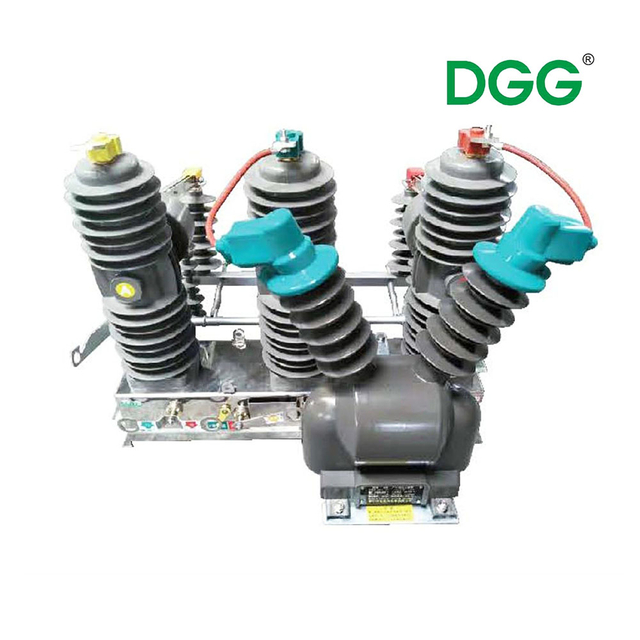
An intelligent outdoor vacuum circuit breaker is more than a mechanical switching device. It combines a primary current-carrying circuit, vacuum interruption technology, outdoor insulation, an operating mechanism, sensing devices, protection and control functions, and optional communication capabilities.
Each component has a specific role. The vacuum interrupter is responsible for interrupting current, the insulation system maintains electrical isolation, the operating mechanism provides opening and closing energy, and the intelligent controller processes protection signals and operating commands.
However, not every outdoor VCB has the same configuration. Current transformers, voltage sensing devices, automatic reclosing, remote communication, and feeder automation functions are normally selected according to the project requirements.
Understanding these components helps utilities, EPC contractors, industrial users, and infrastructure project teams select a product that matches the system voltage, protection strategy, installation environment, and automation needs.
Main systems: Primary circuit, vacuum interrupter, insulation, operating mechanism, sensing, protection, control, and communication
Basic functions: Load-current switching, fault-current interruption, feeder protection, status indication, and local operation
Optional intelligent functions: Automatic reclosing, remote control, current and voltage monitoring, fault recording, and feeder automation
Configuration principle: Components and functions should be selected according to system parameters and project requirements
Customer value: Clearer product selection, better protection coordination, easier system integration, and more accurate quotation
1. Vacuum Interrupter
The vacuum interrupter is the core interrupting component of a vacuum circuit breaker. It contains fixed and moving contacts inside a sealed vacuum chamber.
When the breaker opens under current, an arc forms between the contacts. Because the arc is extinguished in a vacuum environment, the dielectric strength between the contacts can recover rapidly after current interruption.
The vacuum interrupter is responsible for:
Switching normal operating current
Interrupting fault current
Supporting repeated opening and closing operations
Limiting arc duration
Providing the main current-interruption function
Its rated current and short-circuit breaking capacity must match the electrical requirements of the project.
The vacuum interrupter alone does not determine the complete performance of the breaker. Its operation also depends on contact travel, opening speed, closing speed, mechanical linkage, and protection coordination.
2. Primary Conductive Circuit
The primary conductive circuit carries the system current through the breaker. It normally includes terminals, conductive connectors, contacts, internal conductors, and the vacuum interrupter current path.
A reliable primary circuit should provide:
Sufficient current-carrying capacity
Stable electrical contact
Controlled temperature rise
Reliable mechanical connection
Suitable short-time withstand capability
Compatibility with incoming and outgoing conductors
Poor contact or loose connections may increase contact resistance and cause abnormal temperature rise. Therefore, terminal connection, fastening torque, contact condition, and conductor compatibility are important during manufacturing, installation, and commissioning.
3. Outdoor Insulation System
The insulation system separates live parts from grounded structures and maintains the required electrical distance between phases.
An outdoor vacuum circuit breaker may use insulated poles, bushings, external sheds, support insulators, and other insulation components according to its structure.
The insulation system must consider:
Rated voltage
Power-frequency withstand voltage
Lightning impulse withstand voltage
Phase-to-phase clearance
Phase-to-ground clearance
Creepage distance
Pollution level
Altitude
Rain, humidity, dust, and temperature variation
Outdoor insulation design is especially important in high-altitude, polluted, coastal, cold, or humid environments.
The required insulation configuration should be determined according to the project specification rather than selected only by product appearance.
4. Operating Mechanism
The operating mechanism provides the energy required to open and close the breaker. Its performance directly affects the speed, consistency, and reliability of the switching operation.
Depending on the model and project requirements, the breaker may use:
Spring operating mechanism
Motorized mechanism
Permanent-magnet mechanism
Manual operating system
Combined local and remote operation
The operating mechanism must ensure:
Reliable opening and closing
Correct mechanical travel
Suitable opening and closing speed
Stable energy storage
Accurate position indication
Reliable trip and close command execution
Consistent operation across three phases
For intelligent applications, the operating mechanism must also coordinate with the controller, auxiliary power supply, trip circuit, closing circuit, and remote operation commands.
5. Mechanical Transmission and Linkage
The mechanical transmission system connects the operating mechanism to the moving contacts of the breaker. It converts the energy of the mechanism into the required contact movement.
Typical transmission components may include:
Shafts
Connecting rods
Levers
Cranks
Springs
Bearings
Mechanical interlocks
Phase-linkage structures
The transmission system affects:
Contact opening distance
Contact overtravel
Opening and closing synchronization
Mechanical resistance
Operating consistency
Long-term mechanical durability
Incorrect adjustment may lead to incomplete closing, insufficient contact pressure, excessive resistance, or inconsistent phase operation.
The mechanical system should therefore be inspected and adjusted before the breaker is put into service.
6. Current Transformers and Current Sensors
Current measurement is essential for protection and monitoring. Intelligent outdoor VCBs may be equipped with built-in or external current transformers or current sensors.
Their functions may include:
Measuring phase current
Providing signals for overcurrent protection
Detecting short-circuit current
Supporting ground-fault protection
Providing zero-sequence current signals
Supplying data to the intelligent controller
Supporting load monitoring and event recording
The required configuration depends on the protection scheme.
Projects may require:
Three-phase current measurement
Two-phase current measurement
Zero-sequence current detection
Protection-class CTs
Measurement-class CTs
Separate protection and metering signals
The CT ratio, accuracy, burden, protection class, and installation position should match the controller and system requirements.
7. Voltage Transformers and Voltage Sensors
Voltage information may be required for measurement, protection, automatic reclosing, synchronization, directional protection, and distribution automation.
Depending on the project, voltage signals may be provided by:
External voltage transformers
Integrated voltage transformers
Voltage sensors
Capacitive voltage-dividing devices
Station-side measurement systems
Voltage sensing may support:
Voltage monitoring
Loss-of-voltage detection
Live-line verification
Reclosing logic
Directional protection
Power and energy calculation
Feeder automation
Remote system monitoring
Not every outdoor VCB requires an integrated PT. The correct method depends on the system architecture and project requirements.
8. Intelligent Protection Controller
The intelligent controller processes signals from current transformers, voltage sensors, auxiliary contacts, and other field devices. It then executes protection, control, reclosing, monitoring, and communication functions according to the configured logic.
Possible controller functions include:
Phase overcurrent protection
Short-circuit protection
Ground-fault protection
Zero-sequence protection
Automatic reclosing
Fault isolation
Trip and close control
Status monitoring
Protection-setting management
Event recording
Fault recording
Local and remote operation
The controller configuration should match the protection philosophy of the project.
A controller with more functions is not automatically the better choice. The correct solution is the one that matches the system requirements, operation strategy, and communication architecture.
9. Auxiliary Power and Trip/Close Circuits
Intelligent functions require a stable auxiliary power supply. It may be used for the controller, motor mechanism, trip coil, closing coil, communication module, heaters, and other auxiliary devices.
Possible auxiliary power sources include:
Station DC power
Station AC power
External power transformer
Voltage transformer supply
Solar power with energy storage in remote applications
Backup battery, depending on system design
The trip and closing circuits must be designed to ensure that the breaker can operate under required conditions.
Important factors include:
Control voltage
Power consumption
Trip and close coil rating
Backup operating capability
Low-voltage monitoring
Circuit protection
Wiring and terminal arrangement
Environmental protection of the control enclosure
10. Status Indication and Auxiliary Contacts
Operators need clear information about the condition of the breaker. Status indication devices provide local confirmation, while auxiliary contacts transmit information to protection, control, and monitoring systems.
Common status information includes:
Breaker open
Breaker closed
Mechanism energy stored
Trip status
Controller alarm
Local or remote control mode
Lockout status
Auxiliary power condition
Mechanical indicators remain important because they provide direct local confirmation even when the communication system is unavailable.
Auxiliary contacts should also be correctly matched with the control system and checked during commissioning.
11. Communication Module and Remote-Control Interface
Communication functions allow the intelligent outdoor VCB to exchange operating data and control commands with a distribution automation system, SCADA platform, or remote control center.
Depending on the project, the communication system may support:
Remote opening and closing
Status feedback
Current and voltage data
Fault information
Event records
Protection-setting management
Alarm transmission
Time synchronization
Feeder automation coordination
The required communication interface and protocol should be confirmed before production.
Customers should clarify:
Communication protocol
Wired or wireless communication
Control-center interface
Data-point requirements
Remote terminal requirements
Cybersecurity requirements
Responsibility for system integration
Communication capability should be treated as part of the complete project system, not simply as an isolated product feature.
12. Enclosure, Frame and Mounting Structure
The enclosure and support structure provide mechanical protection and installation support for the breaker.
Depending on the model, the product may include:
Main operating enclosure
Intelligent control box
Galvanized support frame
Mounting base
Lifting points
Grounding terminals
Cable-entry points
Maintenance doors
Anti-condensation devices
Environmental seals
The structure should be compatible with:
Pole-mounted installation
Substation bay installation
Outdoor platform installation
Existing foundations
Incoming and outgoing conductor arrangement
Maintenance space
Local wind and seismic requirements, where applicable
A correct mounting design helps reduce installation changes and improve on-site delivery efficiency.
How the Components Work Together
The operation of an intelligent outdoor VCB can be summarized as a coordinated process:
CTs or sensors collect current and voltage signals.
The intelligent controller analyzes the signals according to protection settings.
When a fault condition is detected, the controller sends a trip command.
The operating mechanism drives the moving contact.
The vacuum interrupter interrupts the fault current.
Auxiliary contacts and indicators report the breaker status.
The communication module sends fault and operation information to the control system.
If automatic reclosing is configured, the controller determines whether and when to close the breaker again.
The reliability of the complete system depends on the coordination of all these components—not only the interrupter or controller.
Which Components Are Optional?
Not every project needs the highest level of automation. Optional components and functions may include:
Integrated CTs
Integrated or external PTs
Zero-sequence CT
Intelligent protection controller
Automatic reclosing
Remote communication
Fault recording
Voltage monitoring
Motorized operation
Backup power supply
Anti-condensation heating
Additional interlocking functions
For example:
A substation feeder may use an outdoor VCB with station-side relay protection.
An overhead feeder may require automatic reclosing and remote communication.
An industrial project may require local control but no feeder automation.
A renewable energy project may need specific voltage sensing and protection coordination.
Correct configuration avoids both insufficient functionality and unnecessary cost.
DGG Power Intelligent Outdoor VCB Solutions
DGG Power provides medium- and high-voltage outdoor vacuum circuit breakers for substations, overhead lines, industrial distribution systems, renewable energy grid connection, railway power supply, and infrastructure projects.
According to project requirements, DGG Power can support customers with:
Outdoor VCB model selection
Primary electrical parameter confirmation
CT and PT configuration
Intelligent controller selection
Protection-function coordination
Automatic reclosing configuration
Communication-interface coordination
Installation structure support
Technical drawings and documentation
Factory inspection and testing
Installation and commissioning cooperation
Coordination with disconnect switches, surge arresters, instrument transformers, and fuse cutouts
The goal is not to add every possible function, but to configure a practical solution that matches the actual power system.
FAQ: Intelligent Outdoor VCB Components
What is the most important component of a vacuum circuit breaker?
The vacuum interrupter is the core current-interruption component, but the breaker’s overall reliability also depends on the operating mechanism, insulation system, conductive circuit, mechanical linkage, and protection controller.
Does every intelligent outdoor VCB include CT and PT?
No. CT and PT configurations depend on the protection, measurement, monitoring, and automation requirements of the project. They may be built in, externally installed, or supplied by the existing power system.
What makes an outdoor VCB intelligent?
It becomes intelligent when sensing devices, a protection controller, operating circuits, status feedback, and optional communication functions are integrated to support monitoring, protection, control, and automation.
Is automatic reclosing a standard function?
Not always. Automatic reclosing requires a suitable controller, sensing configuration, operating mechanism, auxiliary power, and protection logic. It should be specified according to the project.
Why do similar outdoor VCBs have different prices?
Differences may come from electrical ratings, vacuum interrupter capacity, insulation level, CT/PT configuration, controller functions, communication protocol, operating mechanism, enclosure protection, documentation, and testing requirements.
Can DGG Power customize the component configuration?
DGG Power can provide project-based configuration support according to system voltage, rated current, fault level, protection requirements, installation method, environmental conditions, and communication needs.
Conclusion
An intelligent outdoor vacuum circuit breaker is a coordinated system consisting of the vacuum interrupter, primary conductive circuit, outdoor insulation, operating mechanism, mechanical linkage, sensing devices, protection controller, auxiliary power, status indication, communication system, and mounting structure.
Understanding the function of each component helps customers avoid selecting equipment only by product appearance or model name. The correct configuration should match the electrical parameters, protection strategy, automation level, site conditions, and long-term operation requirements of the project.
Looking for an intelligent outdoor vacuum circuit breaker for a substation, overhead feeder, industrial system, or distribution automation project? Contact DGG Power with your system parameters, protection requirements, CT/PT configuration, communication needs, and installation conditions. Our technical team will help you configure a suitable solution.