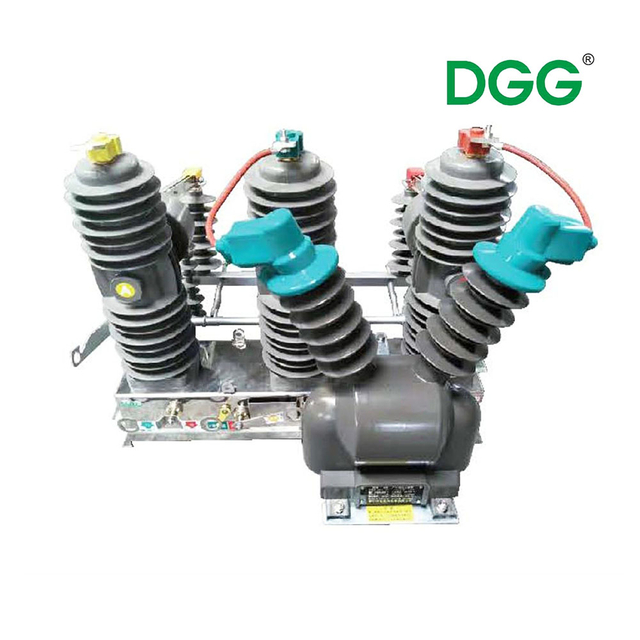
Mountain substations, plateau distribution networks, railway power systems, mining areas, renewable-energy projects and remote infrastructure may expose electrical equipment to high altitude, low temperature, strong temperature variation, wind, dust and condensation.
In these conditions, choosing a circuit breaker only by rated voltage, rated current and short-circuit breaking current is not enough.
A breaker that is suitable for a conventional site at low altitude may require a different insulation configuration, operating mechanism arrangement, auxiliary system or environmental design when installed thousands of meters above sea level or in temperatures well below freezing.
IEC 62271-1 defines normal outdoor service conditions with an ambient temperature range down to −25°C and adopts altitude correction requirements above 1,000 m. Conditions beyond these normal limits need to be treated as special service conditions and evaluated with the equipment manufacturer.
Why Does High Altitude Matter to a Vacuum Circuit Breaker?
The vacuum interrupter itself interrupts current inside a sealed vacuum environment. That often leads to a misunderstanding:
“If the arc is interrupted in vacuum, why should altitude matter?”
Because the vacuum interrupter is only one part of the circuit breaker.
Outside the interrupter, the breaker still depends on external insulation between live parts, phases and grounded structures. At higher altitude, atmospheric pressure and air density decrease. As a result, the dielectric strength of air also decreases.
IEC 62271-1 incorporates altitude correction requirements for installations above 1,000 m. Siemens also states in its medium-voltage vacuum circuit-breaker documentation that the rated lightning impulse and short-time AC withstand levels given under reference conditions apply up to 1,000 m; above this altitude, insulation levels need to be corrected according to the installation altitude.
This does not mean that a breaker rated for a particular system voltage suddenly becomes unusable at 1,001 m.
It means that the insulation capability required at the installation site must be checked against altitude, rather than assuming that the sea-level configuration automatically provides the same dielectric margin at every elevation.
High Altitude Changes More Than One Design Condition
Reduced air density can affect both electrical insulation and heat dissipation.
For equipment that relies partly on surrounding air for insulation and cooling, higher altitude may result in lower dielectric withstand capability and higher temperature rise under the same operating conditions.
ABB's technical guidance for medium-voltage equipment notes that above 1,000 m, thinner air can reduce dielectric withstand capability and cooling performance, which is why altitude correction or application review is required.
However, buyers should be careful with generic “derating tables.”
Different breaker designs, switchgear systems and standards may apply different correction methods. Some product families require correction primarily to insulation level; others may also require current derating or other application changes.
Therefore, a quotation should not simply state:“High altitude available.”
A more useful technical discussion is:At what altitude will the breaker actually operate, and has its insulation and current-carrying capability been evaluated for that location?
Do High-Altitude Breakers Simply Need a Longer Creepage Distance?
Not necessarily.
This is an important distinction.
Altitude correction and creepage distance solve different problems.
High altitude primarily affects the dielectric strength of the surrounding air. This influences air clearances and external insulation withstand requirements.
Creepage distance, on the other hand, is strongly related to surface insulation performance and pollution conditions.
A high-altitude site may also be dusty or polluted, so both issues may exist at the same time. But simply increasing creepage distance does not automatically solve every altitude-related insulation requirement.
For a plateau or mountainous project, the technical specification should therefore identify not only altitude but also pollution level, required insulation withstand levels and environmental conditions.
The correct insulation structure should then be selected as a complete system.
Why Low Temperature Is a Different Engineering Problem
Cold environments affect a breaker in a very different way from high altitude.
IEC 62271-1 defines −25°C as the lower limit of the normal outdoor service-temperature range. Applications below that level require special consideration rather than simply assuming that a standard breaker will behave identically.
At low temperature, the first area of concern is often the operating system rather than the vacuum arc itself.
The mechanism contains moving parts, shafts, bearings, springs, linkages and, depending on the design, lubricated interfaces.
If materials or lubricants are not suitable for the specified minimum temperature, mechanical resistance and operating characteristics may change.
The important question is therefore not simply:“Can the breaker survive −30°C?”
It is:Can the breaker still complete the required opening and closing operations within its specified characteristics at that temperature?
Special low-temperature designs do exist. ABB, for example, specifies outdoor vacuum-breaker configurations designed for operation down to −40°C, demonstrating why minimum operating temperature should be treated as a product-specific design parameter rather than a generic claim for all VCBs.
The Operating Mechanism Deserves Particular Attention
When a protection system issues a trip command, the breaker needs to respond mechanically.
Low temperature can influence the behavior of moving assemblies, lubrication and certain auxiliary components. This becomes particularly important where the breaker is expected to operate after spending long periods outdoors without movement.
A successful cold-climate design therefore needs more than a vacuum interrupter capable of breaking current.
The complete mechanical chain must remain suitable:
trip command → trip coil or actuator → operating mechanism → transmission linkage → contact movement
If one part of that chain becomes sluggish under low-temperature conditions, overall operating performance can be affected.
This is why project buyers should confirm the manufacturer's declared operating-temperature range for the complete breaker, not just for an individual component.
What About the Intelligent Controller and Secondary System?
The issue becomes more complex with intelligent outdoor vacuum circuit breakers.
Modern pole-mounted and outdoor VCBs may include current transformers, voltage sensors, intelligent controllers, communication modules, motorized mechanisms and auxiliary power equipment.
Each of these devices has its own environmental operating range.
A controller specified for a normal climate may not automatically be appropriate for an extreme cold project. Connectors, displays, electronic modules, power supplies and any energy-storage devices included in the control system also need to be evaluated.
If the breaker uses battery backup or solar-powered auxiliary equipment, low-temperature performance of the energy-storage system is another project consideration.
This does not mean that every cold-climate VCB needs a battery heater or special electronic enclosure.
It means that the complete secondary configuration must be checked against the project's actual minimum temperature.
Condensation Can Be as Important as the Minimum Temperature
Cold climate does not always mean continuously dry cold.
Rapid temperature changes can create condensation inside control enclosures and around electrical components.
A breaker may experience a very cold night followed by solar heating during the day, or temperature changes associated with weather and equipment operation.
Moisture and condensation can affect secondary wiring, terminals, control devices and metal components.
ABB's vacuum circuit-breaker guidance notes that where high humidity or rapid and large temperature variation creates condensation risk, appropriate measures such as suitable electric heaters may be required.
For this reason, projects may specify anti-condensation heating or other environmental-control measures inside the mechanism or control enclosure.
But again, this should be based on actual site requirements.
A heater should not be added simply because the words “cold climate” appear in the project title.
High Altitude and Low Temperature Can Occur Together
This is where project selection becomes more interesting.
A plateau railway, mountain substation or remote infrastructure project may simultaneously experience:
reduced air density;
low ambient temperature;
large day-night temperature variation;
wind;
dust;
snow or ice;
difficult maintenance access.
These conditions should not be evaluated independently.
For example, low ambient temperature can influence equipment cooling differently from a high-temperature high-altitude location, while reduced air density still affects dielectric performance.
The manufacturer therefore needs the actual environmental data rather than a vague description such as “high-altitude area.”
The same 3,000 m installation can have very different engineering requirements depending on whether it is located in a cold dry plateau, a dusty mining region or another environment.
Insulation Level Should Be Confirmed Before the Product Structure
For high-altitude VCB projects, customers sometimes begin by choosing the product with the longest visible insulator.
That order should be reversed.
The project should first define the required electrical conditions:
system voltage, equipment highest voltage, power-frequency withstand level, lightning impulse withstand level, installation altitude and pollution requirements.
The manufacturer can then evaluate which insulation structure is appropriate.
Siemens' guidance for medium-voltage vacuum circuit breakers gives a useful example: above 1,000 m, the required rated withstand voltage under reference atmospheric conditions is increased according to the altitude correction factor.
The principle is more important than any single correction number:First determine what insulation performance is required at the site; then select the equipment structure capable of providing it.
Not the other way around.
Does High Altitude Change the Short-Circuit Breaking Capacity?
This should be checked according to the actual product and applicable standard rather than answered with one universal rule.
The vacuum interruption process itself takes place inside the sealed interrupter, so altitude does not affect it in the same way that it affects external air insulation.
Some manufacturer's medium-voltage equipment guidance explicitly states that short-time and interrupting-current ratings of particular vacuum-breaker designs are not affected by altitude, while insulation and continuous-current capability may require correction.
Other equipment systems and standards can have different application rules.
Therefore, buyers should avoid applying a generic derating percentage found online to every VCB.
For a real project, the manufacturer should confirm separately:
insulation capability, continuous-current capability and short-circuit performance
for the selected breaker configuration.
What Should Be Verified During Factory Testing?
A high-altitude or cold-climate breaker should not be treated exactly like a standard project during technical review.
Normal factory verification—such as mechanical operation, primary-circuit checks, insulation testing, secondary control verification and intelligent-function checks—still applies.
But the test and documentation review should also confirm whether the equipment configuration corresponds to the environmental requirements agreed with the customer.
For example, the technical team should be able to connect:
specified minimum temperature → mechanism/controller/environmental configuration → declared operating range
If the project requires special environmental or low-temperature testing beyond the manufacturer's routine factory tests, that requirement should be agreed before production and included in the FAT or technical specification.
This is more reliable than asking after production:“Can we now test whether this normal breaker works at −40°C?”
High-Altitude and Cold-Climate VCB Selection Checklist
Project Information
Why It Matters
Nominal system voltage
Defines the basic breaker voltage class
Highest voltage for equipment
Supports insulation coordination
Installation altitude
Determines whether altitude correction needs to be considered
Confirms suitability of mechanism, controls and materials
Maximum ambient temperature
Supports current-carrying and thermal evaluation
Temperature variation
Helps assess condensation risk
Rated current
Determines continuous-current requirement
Short-circuit breaking current
Defines required fault-interruption capability
Operating mechanism
Must remain suitable across the specified environmental range
Controller / communication configuration
Electronic components must meet site environmental conditions
Auxiliary power arrangement
Important for motorized operation, controls and backup systems
Installation type
Pole-mounted, substation, railway, industrial or other arrangement
Applicable standard / project specification
Defines final design and acceptance requirements
If all of this information is not available at the inquiry stage, customers can provide the technical specification, single-line diagram and environmental data for preliminary review.
A Practical Example: Railway Power Equipment in Harsh Environments
Railway power projects are a good example of why environmental conditions need to be considered early.
DGG Power has supported the China–Kyrgyzstan–Uzbekistan Railway project with electrical equipment including vacuum circuit breakers, voltage transformers, dropout fuse cutouts and insulators for demanding mountainous and low-temperature conditions.
For this type of infrastructure project, equipment selection is not limited to choosing the appropriate voltage class.
Installation altitude, minimum temperature, insulation requirements, operating reliability and future maintenance conditions need to be considered together.
A railway project also illustrates another important principle:
environmental adaptation should be considered at the design and selection stage—not added after the equipment reaches the site.
Where Are High-Altitude Outdoor VCBs Commonly Used?
High-altitude or low-temperature circuit-breaker requirements appear in more applications than railway projects.
Mountain and plateau substations, mining operations, overhead distribution systems, wind and solar projects, remote industrial facilities and cross-border infrastructure can all involve special environmental conditions.
Renewable-energy projects are particularly relevant because wind and solar resources are often developed in remote regions where environmental conditions differ significantly from standard urban distribution sites.
ABB's current outdoor vacuum-circuit-breaker portfolio, for example, lists medium-voltage distribution networks as well as wind and solar plants among typical applications, while also offering product designs for demanding environmental conditions.
The application alone, however, does not define the required breaker.
The site data does.
DGG Power High-Altitude and Cold-Climate Project Support
DGG Power provides medium- and high-voltage transmission and distribution equipment for substations, overhead distribution networks, infrastructure, industrial and renewable-energy projects.
For high-altitude or cold-climate outdoor VCB applications, the technical discussion can begin before a final model is selected.
Customers can provide the system parameters together with installation altitude, minimum and maximum ambient temperature, insulation requirements, environmental conditions, controller configuration and project technical specification.
DGG Power can then evaluate the breaker configuration according to the project requirements and coordinate related technical documentation, factory verification and commissioning support.
The goal is not simply to label a product:
“High-Altitude VCB”
or:
“Cold-Climate Circuit Breaker.”
A more useful result is to establish a traceable relationship between:
That is what makes environmental adaptation meaningful in a real power project.
FAQ: High-Altitude and Cold-Climate Outdoor Vacuum Circuit Breakers
At what altitude should VCB altitude correction be considered?
Under IEC 62271-1, altitude correction provisions apply above 1,000 m for high-voltage switchgear and controlgear under the relevant conditions. The actual correction method and equipment selection should follow the applicable product standard and manufacturer guidance.
Why does altitude affect a vacuum circuit breaker if interruption occurs in vacuum?
The arc is interrupted inside the vacuum interrupter, but the complete breaker also relies on external air insulation between phases, live parts and grounded structures. Lower air density at higher altitude reduces dielectric strength.
Is longer creepage distance enough for a high-altitude project?
Not necessarily. Altitude correction mainly addresses reduced air dielectric strength, while creepage distance is closely related to surface insulation and pollution. Both need to be evaluated according to the site.
Can a standard outdoor VCB operate below −25°C?
IEC 62271-1 defines −25°C as the lower limit of the normal outdoor service-temperature range. Applications below that should be treated as special service conditions and confirmed with the manufacturer. Some specially designed outdoor vacuum breakers are available for lower temperatures, including −40°C designs.
Does low temperature affect the vacuum interrupter?
The sealed vacuum interruption principle itself is only part of the breaker. In cold-climate applications, particular attention should also be given to the operating mechanism, lubrication, secondary components, auxiliary power and environmental control.
Does every cold-climate breaker need a heater?
No. Heating or anti-condensation measures depend on the enclosure design, humidity, temperature variation and project requirements. They should not be treated as a universal requirement for every cold application.
What information should I send before requesting a high-altitude VCB quotation?
Provide system voltage, rated current, short-circuit requirement, installation altitude, minimum and maximum temperature, required insulation levels, pollution conditions, controller requirements, installation arrangement and the project technical specification.
Conclusion
Selecting an outdoor vacuum circuit breaker for a high-altitude or cold-climate project is not simply a matter of choosing a standard breaker and adding the words “special environment.”
High altitude can reduce the dielectric strength and cooling capability of air. Low temperature can introduce additional requirements for the operating mechanism, secondary equipment and environmental control. When both occur together, the equipment should be evaluated as one complete system.
The most important step is therefore to provide environmental information before finalizing the breaker configuration.
A technically sound selection process should establish a clear relationship between:
installation altitude → insulation requirement
minimum temperature → operating and control-system requirement
project function → controller and protection configuration
For EPC contractors, utilities and infrastructure project buyers, this approach provides a much stronger basis for equipment selection than simply requesting a “high-altitude VCB.”
If you are selecting an outdoor vacuum circuit breaker for a plateau, mountain, railway, renewable-energy or cold-region project, send DGG Power your system parameters, installation altitude, temperature range, insulation requirements, site conditions and technical specification. Our team can help evaluate an appropriate project configuration.