Renewable-energy projects such as photovoltaic and wind power plants eventually need to connect their generated electricity to the wider power system.
At that point, the project is no longer only about solar modules, inverters or wind turbines. The grid-connection system must also handle switching, protection, isolation, measurement, control and fault interruption.
In a medium-voltage grid-connection feeder, the VCB may be required to carry normal operating current, execute switching commands and interrupt fault current when the protection system determines that the circuit should be disconnected.
However, there is no single “solar circuit breaker” configuration that can be copied from one renewable-energy project to another.
Even two projects both described as 35 kV photovoltaic grid connection may require different breakers because their rated current, fault level, protection arrangement, installation environment and control requirements are different.
This is why VCB selection should begin with the power-system design rather than the project label.
What Role Does an Outdoor VCB Play in a Renewable-Energy Grid Connection?
A renewable-energy plant normally connects to the grid through a sequence of collection circuits, transformers, switching equipment and substations.
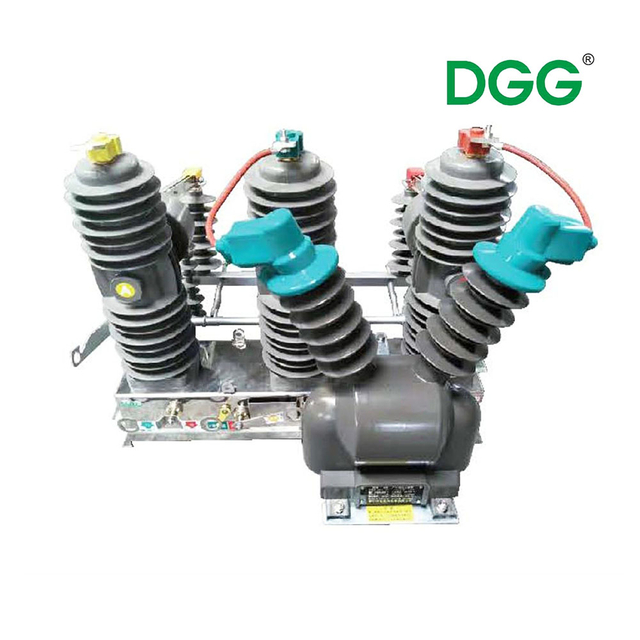
Depending on the project architecture, an outdoor VCB may be installed on a feeder, at a substation bay or at another switching point between the generation system and the utility network.
Its role is primarily electrical.
During normal operation, the breaker carries the circuit current and responds to planned switching commands. When the protection system detects a condition that requires disconnection, the breaker receives the trip command and interrupts the current.
This means that the VCB should not be treated as an isolated product.
Its real performance depends on how it coordinates with the protection relay or intelligent controller, CTs and PTs or other sensing devices, auxiliary power supply, control circuits and the upstream and downstream network.
In a grid-connection project, this complete coordination is more important than simply purchasing a breaker with the correct voltage written on the nameplate.
Why a 35 kV Project Cannot Be Selected by Voltage Alone
Suppose two photovoltaic projects both connect to a 35 kV system.
It would be easy to assume that they should use the same outdoor vacuum circuit breaker.
But that is not necessarily correct.
One project may have a higher plant capacity and therefore require a different rated current. Another may be located at a substation where the prospective short-circuit current is higher. A third project may require remote control and communication with a dispatch or substation automation system.
Environmental conditions can also change the final configuration.
A 35 kV project in a conventional low-altitude area is different from a 35 kV installation located on a plateau, in a heavily polluted industrial environment or in a region with very low winter temperatures.
So “35 kV” only tells us the system voltage class.
It does not tell us everything needed to select the breaker.
A complete selection still needs to consider:
system voltage → rated current → short-circuit duty → insulation level → protection scheme → control and communication → installation environment
That sequence gives a much more reliable basis for equipment selection.
Rated Current Should Follow the Actual Power Flow
Renewable-energy projects can vary greatly in installed capacity and feeder arrangement.
For this reason, the rated current of the breaker should be selected according to the actual current that the feeder or bay is expected to carry, together with the project design margin and applicable technical requirements.
It is not appropriate to choose the largest available current rating simply because a larger number appears safer.
A breaker that is significantly oversized may increase cost and change the equipment configuration without providing meaningful value to the project.
The better approach is to begin with the project's electrical design and confirm the expected operating current before selecting the rated current.
For EPC and utility projects, the single-line diagram is usually one of the most useful documents for this discussion.
Short-Circuit Breaking Capacity Is a Separate Requirement
Rated current and short-circuit breaking current describe two very different operating conditions.
Rated current relates to the continuous current the breaker carries during normal operation.
Short-circuit breaking current relates to the fault current the breaker may be required to interrupt.
A renewable-energy feeder may operate at a relatively moderate normal current while still being connected to a network with a much higher available fault current.
Therefore, the breaker must be selected according to the short-circuit level calculated for the actual installation point.
This is especially important when a renewable-energy project is connected to an existing utility substation.
The grid side can significantly influence the available fault level, so the breaker should not be selected only according to the generating capacity of the solar or wind plant.
Protection Coordination Determines When the VCB Should Operate
The circuit breaker does not independently decide when to trip.
That decision normally comes from the protection system.
CTs, PTs or other sensing devices provide electrical signals. The protection relay or intelligent controller evaluates those signals according to the configured settings. If the protection criteria are met, a trip command is sent to the breaker.
The breaker then performs the physical interruption.
If any part of that chain is incorrectly configured, the grid-connection system may not operate as expected even when the breaker itself is mechanically healthy.
This is why VCB selection for renewable-energy projects should be discussed together with protection requirements rather than treated as an independent purchasing decision.
CT and PT Configuration Should Match the Project
Measurement and protection requirements vary from one renewable-energy project to another.
Some projects obtain current and voltage signals from separate instrument transformers installed in the substation. Others may use integrated sensing configurations depending on the equipment design.
The key question is not whether the breaker has “more sensors.”
The important question is whether the sensing system provides the signals required by the project's protection, measurement and control scheme.
For example, the project may need current information for overcurrent protection, voltage information for monitoring or protection logic, and additional signals for remote supervision.
These requirements should be confirmed before the breaker and controller configuration is finalized.
Remote Control and Communication Are Increasingly Important
Many renewable-energy plants are located far from major cities or are operated with limited on-site personnel.
As a result, remote monitoring and control are often important parts of the overall project design.
Where required, an intelligent outdoor VCB can be configured to work with the project's control system and provide status information, alarms and operating commands through the specified communication architecture.
But communication should never be treated as a generic feature.
The protocol, data points, remote-control authority, interface responsibility and cybersecurity requirements should be clarified during the project design stage.
A breaker described as “smart” is not automatically compatible with every SCADA or automation system.
For international EPC projects, communication requirements should therefore be included in the technical specification before production.
Automatic Reclosing Is Not Always the Right Default
Automatic reclosing is widely used in overhead distribution networks because many faults can be temporary.
However, renewable-energy grid-connection projects may have different operating philosophies depending on the feeder type, generation system, protection strategy and utility requirements.
Therefore, automatic reclosing should not simply be enabled because the controller supports it.
The project should first determine whether reclosing is permitted, under what conditions it can operate and how it coordinates with the generation system and utility protection.
For some projects, different control logic may be required after the breaker trips.
This is another example of why the final function set should be driven by the project rather than by the maximum number of available controller features.
Outdoor Environment Still Matters
Renewable-energy projects are often built where the energy resource is strongest rather than where the environment is easiest for electrical equipment.
Solar plants may be located in dry, dusty or high-altitude areas. Wind projects may be exposed to strong wind, low temperatures or coastal environments.
The outdoor VCB therefore needs to be evaluated according to the actual site conditions.
Insulation level, creepage requirement, minimum and maximum temperature, altitude, contamination and condensation risk may all influence the final product configuration.
This also links directly to high-altitude and cold-climate VCB selection.
A project can be both a renewable-energy application and a special-environment application at the same time.
Installation and Commissioning Are Part of the Grid-Connection Process
Even a correctly selected breaker still needs to be installed and commissioned correctly.
During site work, the equipment condition, primary connections, control circuits, status feedback and protection interfaces need to be verified according to the project requirements.
The purpose of commissioning is not simply to confirm that the breaker can open and close.
The more important question is whether the complete system behaves correctly:
When the protection system issues a trip command, does the breaker respond?
Does the controller receive the correct status afterward?
Do the local and remote indications agree?
Are the protection and control functions consistent with the approved design?
These checks turn the equipment from an individual product into part of a working grid-connection system.
DGG Power 35 kV Photovoltaic Grid-Connection Project Experience
DGG Power has supported a 35 kV photovoltaic grid-connection feeder associated with a 110 kV substation, providing a new floor-standing outdoor high-voltage circuit breaker together with installation and commissioning support.
For this type of project, the equipment is not evaluated only by its individual product parameters.
The breaker needs to fit into the existing substation system, coordinate with the project protection and control requirements and be correctly installed and verified before operation.
This type of field experience is valuable because renewable-energy grid connection is ultimately an engineering-integration task.
Product manufacturing is only one part of the delivery process.
Equipment selection, technical confirmation, installation, commissioning and project coordination all contribute to the final result.
What Information Should Be Provided Before Requesting a Quote?
Project Information
Why It Matters
Grid-connection voltage
Determines the basic breaker voltage class
Highest voltage for equipment
Supports insulation coordination
Plant / feeder capacity
Helps determine expected operating current
Rated current requirement
Defines continuous-current capability
Short-circuit current
Determines required breaking capacity
Protection scheme
Defines how and when the breaker should trip
CT / PT requirements
Supports measurement and protection configuration
Control voltage
Determines secondary operating configuration
Communication protocol
Required for remote control and system integration
Automatic reclosing requirement
Must follow the project protection philosophy
Installation altitude
May affect insulation requirements
Ambient temperature range
Helps confirm environmental suitability
Pollution / creepage requirement
Supports external insulation selection
Installation arrangement
Pole-mounted, substation bay, floor-standing or other configuration
Technical specification
Defines final design, testing and acceptance requirements
If complete parameters are not yet available, the single-line diagram, protection scheme and project technical specification can provide a useful starting point.
DGG Power Support for Renewable-Energy Grid-Connection Projects
DGG Power provides medium- and high-voltage transmission and distribution equipment for substations, distribution systems, infrastructure and renewable-energy projects.
For outdoor VCB applications, DGG Power can support customers from the early technical stage through equipment delivery.
Depending on the project scope, this may include breaker selection, CT/PT coordination, controller configuration, technical-document review, factory testing, FAT support, installation and commissioning coordination.
The objective is not simply to supply a breaker marked with the correct voltage.
For renewable-energy projects, that complete relationship is what turns a switching device into part of a reliable grid-connection solution.
FAQ: Outdoor VCBs for Renewable-Energy Grid Connection
Can an outdoor vacuum circuit breaker be used for solar power grid connection?
Yes. Outdoor VCBs can be used in medium-voltage photovoltaic grid-connection feeders when their electrical ratings, protection configuration, insulation level and control functions meet the project requirements.
Is a special “solar vacuum circuit breaker” required?
Not necessarily. The vacuum interruption principle is the same. The final breaker configuration should be selected according to the grid voltage, rated current, short-circuit duty, protection scheme, control requirements and site environment.
How do I choose a 35 kV VCB for a photovoltaic project?
The system voltage alone is not enough. The project should also confirm the highest voltage for equipment, rated current, short-circuit breaking current, insulation level, protection arrangement, CT/PT configuration, control voltage, communication and environmental conditions.
Does every renewable-energy VCB need remote communication?
No. Communication is required only where it is part of the project control or automation architecture. The protocol and interface requirements should be confirmed during design.
Should automatic reclosing be enabled on a solar grid-connection feeder?
Not automatically. The use of automatic reclosing should follow the utility requirements, feeder type, generation characteristics and overall protection philosophy.
What should be checked during commissioning?
Commissioning should verify primary connections, breaker operation, secondary circuits, protection interfaces, status feedback and project-specific control or communication functions.
Conclusion
Selecting an outdoor vacuum circuit breaker for a renewable-energy grid-connection project requires more than choosing a voltage class.
The breaker must match the actual operating current, short-circuit level, insulation requirements, protection scheme, control architecture and site environment.
More importantly, the VCB should be considered as part of the complete grid-connection system.
For utilities, EPC contractors and renewable-energy project developers, getting this relationship right during the design and procurement stage can significantly simplify later factory testing, commissioning and operation.
If you are selecting an outdoor vacuum circuit breaker for a photovoltaic, wind-power or renewable-energy grid-connection project, send DGG Power your system voltage, rated current, short-circuit level, protection scheme, CT/PT requirements, communication needs and technical specification. Our team can help evaluate the appropriate project configuration.