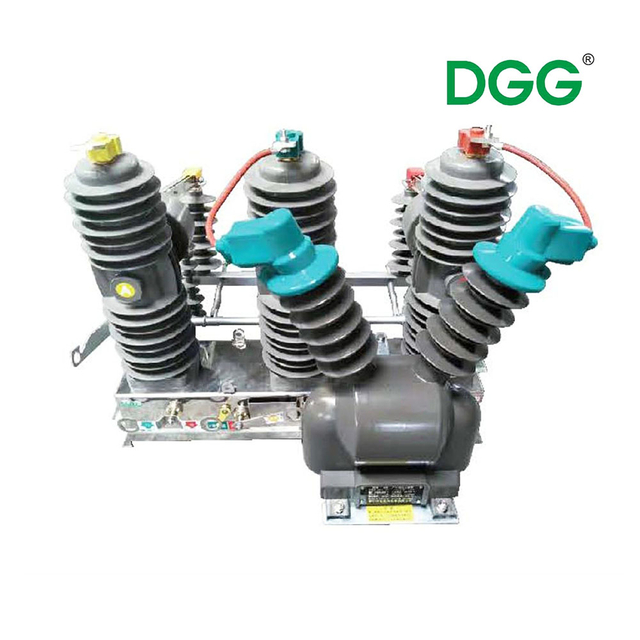
Outdoor vacuum circuit breakers are widely used in substations, overhead distribution networks, industrial power systems and feeder protection applications. Their job is straightforward in principle: carry normal current, respond to protection or control commands and interrupt current when required.
In actual operation, however, a circuit breaker is not just a vacuum interrupter.
Its performance depends on the coordination of the operating mechanism, primary conductive circuit, insulation system, trip and closing circuits, auxiliary power supply, current or voltage sensing devices, controller and status-feedback system.
This is why a breaker that “does not close,” “does not trip” or “shows an abnormal signal” should not immediately be treated as a failed vacuum interrupter.
A more useful maintenance approach is to follow the complete operating chain and determine where the abnormal condition begins.
Actual maintenance procedures and intervals, however, should follow the specific breaker design, manufacturer instructions, operating duty and service environment.
The Breaker Does Not Close
Failure to close is one of the most common symptoms encountered during circuit-breaker operation, but it can have several different causes.
If a closing command is issued but nothing happens, the first question should not be whether the vacuum interrupter is damaged. The problem may instead be related to the auxiliary power supply, closing circuit, control relay, interlock condition, stored-energy mechanism or controller output.
For spring-operated breakers, insufficient energy storage can prevent the mechanism from completing the closing operation. For electrically operated equipment, incorrect control voltage, an open secondary circuit or an interlock that has not been released may produce a similar symptom.
The important diagnostic principle is to separate the problem into stages:
Was the closing command generated? Was it transmitted through the secondary circuit? Did the operating mechanism receive it? And did the mechanism complete the required mechanical movement?
Once these questions are answered in sequence, troubleshooting becomes much more efficient than repeatedly operating the breaker without understanding the cause.
The Breaker Does Not Trip When Expected
A breaker that fails to trip requires careful investigation because the problem may exist anywhere between fault detection and mechanical opening.
In an intelligent outdoor VCB system, current or voltage signals may first be processed by a protection controller. When the configured protection condition is satisfied, the controller sends a trip command through the secondary circuit to the trip coil or operating mechanism.
If the breaker does not open, technicians therefore need to determine whether the protection function actually operated, whether the trip signal was issued, whether the trip circuit remained continuous and whether the mechanism responded correctly.
A mechanical problem and a secondary-control problem can produce the same visible result.
For this reason, testing the breaker body alone may not identify the real fault.
This is especially important for intelligent VCBs equipped with protection controllers, automatic reclosing or remote-control functions, because the complete protection chain includes both primary and secondary equipment.
Slow, Unstable or Inconsistent Mechanical Operation
An outdoor VCB may still complete an opening or closing operation while showing signs that the mechanism requires attention.
Changes in operating speed, increased mechanical resistance, unusual vibration, inconsistent movement or difficulty completing the full operating stroke may indicate that the transmission mechanism, linkage, lubrication condition, springs or mechanical adjustments should be checked.
Operating mechanisms are precision assemblies. Small changes in travel or linkage condition can affect contact movement and operating consistency.
Maintenance should therefore focus not only on whether the breaker can move, but also on whether it completes the required movement correctly and consistently.
Manufacturer instructions commonly include inspection of mechanical components, operating mechanisms, lubrication points and wear according to the specific breaker design. Some vacuum breakers are designed for long maintenance-free operating periods under normal service conditions, while harsher or more frequent operating duty may require more frequent inspection.
The Position Indication Does Not Match the Actual Breaker Position
Another maintenance issue occurs when the physical breaker position and the electrical status indication do not agree.
For example, the breaker may be mechanically open while the controller or remote system still reports a closed condition.
This does not necessarily mean that the main breaker mechanism has failed.
The abnormality may be related to an auxiliary contact, position switch, secondary wiring, connector, controller input or communication mapping.
This type of problem becomes particularly important in distribution automation systems.
A remote control center depends on accurate field information. If the status signal is incorrect, operators may make decisions based on a condition that does not match the actual equipment state.
During commissioning and maintenance, the mechanical position indication, auxiliary-contact feedback and controller status should therefore be checked against each other.
Abnormal Heating at Terminals or Conductive Connections
Abnormal temperature rise around terminals, connectors or conductive joints should not be ignored.
The primary circuit carries the operating current of the system. If a connection becomes loose, contaminated, oxidized or mechanically damaged, contact resistance can increase and create localized heating.
This issue may not immediately prevent the breaker from operating, which is why it can remain unnoticed until discoloration, damaged insulation or abnormal temperature becomes more obvious.
When abnormal heating is detected, technicians should identify the exact location and check the associated conductive connection rather than assuming that the vacuum interrupter itself is responsible.
Correct installation, connection condition and fastening are therefore important both during initial commissioning and throughout the equipment's service life.
Outdoor Insulation Contamination and Surface Condition
Unlike indoor equipment, outdoor vacuum circuit breakers are directly exposed to environmental conditions.
Dust, industrial contamination, moisture, rain, salt deposits and other contaminants can accumulate on insulation surfaces. Under certain conditions, this contamination can reduce external insulation performance and contribute to surface discharge or tracking.
Visual inspection of the external insulation should therefore pay attention to contamination, cracks, damaged sheds, abnormal discharge traces and other visible deterioration.
Cleaning methods and maintenance frequency should follow the insulation material, contamination severity and manufacturer's instructions.
Service environment matters. Eaton's maintenance documentation, for example, recommends more frequent inspection for equipment operating in dusty or corrosive environments than under normal conditions.
For outdoor equipment, environmental inspection should therefore be based on actual site conditions rather than a universal calendar interval.
How Should the Vacuum Interrupter Be Checked?
The vacuum interrupter is the core current-interrupting component of a VCB, but its internal condition cannot be reliably evaluated simply by looking at its external appearance.
Because the interrupter is sealed, operators should not attempt to disassemble it as part of routine maintenance.
Instead, its condition should be evaluated using the inspection and test methods specified by the breaker manufacturer. Depending on the breaker design and maintenance procedure, this may include electrical withstand verification, mechanical-operation checks and other prescribed tests.
Modern vacuum interrupters can offer long operating life, and many breaker designs require little or no direct maintenance of the interrupter itself under normal service conditions. Siemens, for example, specifies defined maintenance-free operating-cycle ranges for several vacuum circuit-breaker families under stated normal conditions.
This does not mean that the entire breaker should be ignored until failure.
The interrupter may require little direct servicing, while the mechanism, insulation, conductive connections and secondary system still require condition-based inspection.
Intelligent Controller or Sensor Signals Become Abnormal
For intelligent outdoor vacuum circuit breakers, troubleshooting increasingly involves secondary electronics as well as mechanical equipment.
An abnormal current value, incorrect voltage reading, unexpected alarm or missing status signal may originate from the sensing device, wiring, connector, auxiliary power supply, controller configuration or communication system.
Before replacing the controller, technicians should confirm whether the input signal reaching the controller is correct.
This distinction is important because replacing a healthy controller will not correct an upstream sensing or wiring problem.
For systems equipped with CTs, voltage sensors, zero-sequence sensing or other measurement devices, signal verification should therefore be part of the troubleshooting process.
The same principle applies to communication problems. A breaker may operate perfectly at the local level while failing to transmit the expected information to the remote system.
In that situation, the problem may lie in the communication interface rather than the primary switching device.
Automatic Reclosing Does Not Work as Expected
When an intelligent outdoor VCB is configured for automatic reclosing, successful operation depends on more than the breaker mechanism.
The controller must detect the fault condition, issue the trip command, complete the programmed timing sequence and confirm that the conditions for reclosing are satisfied before sending a closing command.
If reclosing does not occur, the breaker itself may still be functioning correctly.
The issue may be related to protection settings, reclosing enable/disable status, lockout logic, voltage conditions, controller programming, auxiliary power or secondary wiring.
Conversely, repeated unexpected reclosing should not simply be solved by forcing the breaker back into service. The protection and reclosing logic should first be reviewed.
Automatic reclosing strategies depend on the network and application. They should therefore follow the project protection philosophy rather than being treated as a universal default function.
Equipment That Has Been Out of Service for a Long Time
A breaker that has remained unused for an extended period should not automatically be returned to service simply because it operated correctly before storage or shutdown.
Before re-energization, the equipment condition should be checked according to the manufacturer's commissioning and maintenance instructions.
Attention should be given to the operating mechanism, insulation cleanliness, conductive connections, control power supply, wiring, position indication and operating function.
Storage conditions can also matter. Moisture and condensation can affect components and contribute to corrosion, which is why some vacuum-breaker designs include heaters or anti-condensation measures for specific applications.
A controlled inspection before re-energization is therefore more appropriate than assuming that inactivity means the equipment has experienced no deterioration.
How Often Should an Outdoor Vacuum Circuit Breaker Be Maintained?
There is no single maintenance interval that is correct for every outdoor vacuum circuit breaker.
This point is important.
Different manufacturers specify different maintenance requirements according to breaker design, mechanical life, electrical duty and operating environment.
Therefore, maintenance planning should consider:
manufacturer instructions + number of operations + fault interruption history + operating environment + equipment condition.
A breaker that operates frequently, interrupts significant fault currents or works in a polluted outdoor environment may require different attention from a lightly operated breaker in a relatively clean location.
Practical Maintenance Checkpoints
Inspection Area
What to Check
Operating Mechanism
Verify smooth opening and closing operations, linkage condition, spring mechanism (if applicable), and correct operating travel.
Primary Terminals
Check for loose connections, abnormal heating, corrosion, oxidation, and visible mechanical damage.
Outdoor Insulation
Inspect for contamination, cracks, damaged sheds, moisture accumulation, and signs of surface discharge or tracking.
Position Indication
Confirm that the mechanical position indicator matches the electrical status feedback and remote monitoring system.
Trip & Closing Circuits
Verify control voltage, circuit continuity, trip/close coils, and command execution.
Auxiliary Contacts
Check that open/close status feedback operates accurately and consistently.
Intelligent Controller & Sensors
Verify current and voltage measurements, controller alarms, sensor signals, and parameter settings.
Communication System
Confirm reliable remote monitoring, status reporting, and command transmission where communication functions are enabled.
Vacuum Interrupter
Evaluate according to the manufacturer's recommended inspection and testing procedures. Do not disassemble the interrupter during routine maintenance.
If there is no closing command, troubleshooting begins with the control or protection system.
If the command exists but does not reach the closing coil, the secondary circuit becomes the focus.
If the coil operates but the mechanism does not complete the movement, attention shifts to the mechanical system.
If the breaker closes correctly but the remote platform still reports “open,” the problem should be investigated in the feedback or communication chain.
This method avoids treating every symptom as a primary-equipment failure and can significantly narrow the troubleshooting scope.
Safety Comes Before Maintenance
Maintenance work on medium- and high-voltage circuit breakers should only be performed by qualified personnel following the applicable operating and safety procedures.
Equipment must be placed in a safe condition before inspection or maintenance. Manufacturer instructions commonly require the circuit breaker and associated equipment to be de-energized and grounded before maintenance work begins.
Remote control and automatic reclosing functions also need particular attention. Technicians must ensure that unintended remote or automatic operation cannot occur while personnel are working on the equipment.
The exact isolation, grounding, lockout and verification procedures should follow the utility, project and site safety requirements.
DGG Power Support for Outdoor Vacuum Circuit Breakers
DGG Power provides medium- and high-voltage outdoor vacuum circuit breakers for distribution networks, substations, industrial power systems, infrastructure projects and renewable-energy applications.
For project-based applications, equipment support does not end with product delivery.
Depending on the project scope, DGG Power can support customers with equipment selection, technical-document review, factory testing, commissioning coordination, operating-function verification and troubleshooting communication.
For intelligent outdoor VCB applications, technical discussions can also cover the breaker body, operating mechanism, CT or sensing configuration, controller functions, automatic reclosing and communication requirements.
The purpose is to help customers evaluate the complete breaker system instead of treating the primary device and secondary control equipment as unrelated components.
FAQ: Outdoor Vacuum Circuit Breaker Maintenance
Why does an outdoor vacuum circuit breaker fail to close?
Failure to close may be related to the auxiliary power supply, control circuit, interlock, stored-energy condition, closing coil, operating mechanism or controller command. The operating chain should be checked step by step before concluding that the primary breaker is defective.
Does a vacuum interrupter require regular replacement?
Not simply because a fixed calendar period has passed. Vacuum interrupter life depends on the breaker design, electrical duty and operating history. Inspection and replacement criteria should follow the manufacturer's instructions.
Can outdoor insulation contamination affect breaker operation?
Contamination can affect external insulation performance, particularly under adverse environmental conditions. The insulation surface should therefore be inspected and maintained according to the actual site environment and manufacturer guidance.
Why is my controller showing the wrong breaker position?
Possible causes include auxiliary-contact problems, position switches, secondary wiring, controller inputs or communication mapping. The actual mechanical position should first be compared with the local electrical feedback.
How often should an outdoor VCB be inspected?
There is no universal interval for all VCBs. Inspection frequency depends on the breaker design, manufacturer requirements, operating cycles, fault-interruption history and environmental conditions.
What should be checked before a long-idle breaker is returned to service?
The inspection should follow the manufacturer's commissioning procedure and typically considers mechanism condition, insulation, primary connections, control circuits, auxiliary power and operating functions before energization.
Conclusion
Outdoor vacuum circuit breaker maintenance is not simply a matter of cleaning the equipment or checking whether it can open and close.
A modern VCB is a coordinated system involving primary conductive components, vacuum interruption, insulation, mechanical operation, secondary circuits, protection logic and status feedback.
When an abnormal condition occurs, the most effective approach is therefore to identify where the complete operating chain stops behaving as expected.
Correct maintenance also means avoiding two extremes: waiting until the equipment fails, or applying the same rigid maintenance schedule to every breaker regardless of its design and operating condition.
If you are experiencing abnormal operation with an outdoor vacuum circuit breaker, or need technical support for a new distribution, substation or feeder project, send DGG Power the breaker model, system voltage, operating symptom, controller configuration, site conditions and available test information. Our technical team can help evaluate the next troubleshooting or project-support steps.