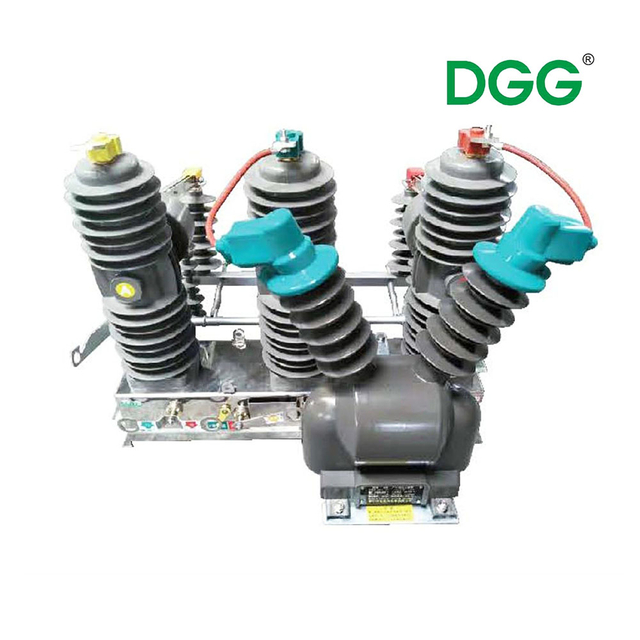
Outdoor vacuum circuit breakers and auto reclosers are both widely used in medium- and high-voltage distribution systems. They can interrupt fault current, protect feeder circuits, and support reliable power distribution. Because some intelligent outdoor vacuum circuit breakers can also be configured with automatic reclosing functions, customers often wonder whether the two products are actually the same.
The key difference is their main design focus.
An outdoor vacuum circuit breaker is primarily a switching and fault-interruption device that uses a vacuum interrupter. An auto recloser is a complete protection and control device designed to detect faults, interrupt current, and automatically restore the circuit according to preset reclosing logic.
In practical projects, the boundary between the two may overlap. An intelligent outdoor vacuum circuit breaker equipped with current and voltage sensing, a protection controller, communication functions, and automatic reclosing logic may perform functions similar to an auto recloser.
This article explains the differences, similarities, applications, and selection considerations to help utilities, EPC contractors, industrial users, and infrastructure project teams choose the right solution.
Article Summary
Outdoor vacuum circuit breaker: Focuses on circuit switching and fault-current interruption using vacuum interrupter technology
Auto recloser: Focuses on fault detection, interruption, automatic reclosing, and feeder automation
Main overlap: An intelligent outdoor VCB can support automatic reclosing when equipped with a suitable controller and sensing system
Typical VCB applications: Substation feeders, industrial distribution, renewable energy grid connection, and outdoor switching points
Typical recloser applications: Overhead feeders, rural distribution networks, remote line sections, and feeder automation
Selection factors: System voltage, fault current, reclosing logic, protection functions, CT/PT configuration, communication, and operating environment
DGG Power support: Outdoor VCB and auto recloser selection, intelligent controller configuration, technical documentation, testing, and project support
What Is an Outdoor Vacuum Circuit Breaker?
An outdoor vacuum circuit breaker is a switching and protection device designed for outdoor power systems. It uses a vacuum interrupter to extinguish the arc when opening the circuit.
Its basic functions include:
Opening and closing circuits
Carrying rated current
Interrupting short-circuit current
Supporting feeder protection
Isolating faulted circuits when coordinated with protection devices
Providing manual, motorized, or intelligent operation according to configuration
Outdoor VCBs are commonly used in substations, overhead distribution systems, industrial power networks, renewable energy grid-connection projects, railway power systems, and infrastructure applications.
A conventional outdoor VCB may mainly perform switching and fault interruption. An intelligent model may also include protection, monitoring, automatic reclosing, communication, and remote-control functions.
What Is an Auto Recloser?
An auto recloser is a protection and switching device commonly used in overhead distribution networks. It detects abnormal current or fault conditions, opens the circuit, waits for a preset time, and then attempts to close the circuit again according to programmed logic.
The purpose of reclosing is to restore power after temporary faults.
Temporary faults may include:
Lightning-related flashover
Temporary tree contact
Wind-related conductor contact
Short-duration external interference
Transient insulation disturbances
If the fault disappears, the recloser can restore the feeder automatically. If the fault remains, the device can trip again and eventually lock out after the configured number of attempts.
A typical auto recloser system may include:
Vacuum or other interrupting unit
Current sensing
Voltage sensing, when required
Protection controller
Reclosing logic
Local and remote control
Communication interface
Event and fault recording
The Main Difference: Device Function vs Protection Logic
The clearest way to understand the difference is:
An outdoor vacuum circuit breaker describes the switching device and its vacuum interruption technology. An auto recloser describes a protection and control function that includes automatic reclosing.
A VCB can exist without automatic reclosing. It may be operated locally or remotely and trip only when instructed by an external protection relay or controller.
A recloser must include a reclosing control strategy. It needs to detect the fault, interrupt the circuit, wait for a configured interval, and determine whether to re-energize the feeder.
Therefore:
Every auto recloser contains an interrupting device
Many auto reclosers use vacuum interrupters
Not every outdoor vacuum circuit breaker is an auto recloser
An intelligent outdoor VCB can perform recloser functions when suitably configured
Comparison Table
Comparison Item
Outdoor Vacuum Circuit Breaker
Auto Recloser
Main focus
Switching and fault interruption
Fault detection, interruption, and automatic reclosing
Overhead feeders, line sectionalizing, remote distribution networks
Operation logic
Local, remote, or protection-command operation
Automatic trip-reclose-lockout sequence
Automation level
Depends on configuration
Usually designed for feeder automation
Selection focus
Electrical rating and switching requirements
Electrical rating, protection logic, reclosing strategy, and communication
Can an Outdoor Vacuum Circuit Breaker Work as an Auto Recloser?
Yes, but only when the required protection and control functions are included.
A suitable intelligent outdoor VCB may operate as a recloser when it is equipped with:
Current transformers or current sensors
Voltage transformers or voltage sensors, when required
Intelligent protection controller
Automatic reclosing logic
Trip and closing power supply
Motorized operating mechanism
Local and remote control
Communication module
Fault and event recording
The breaker body alone does not create a complete auto recloser system. The sensing, control, protection, communication, and reclosing logic are equally important.
This is why buyers should not judge only by the external appearance of the equipment. Two products with similar breaker structures may have very different protection and automation capabilities.
When Should You Choose an Outdoor Vacuum Circuit Breaker?
An outdoor VCB may be more suitable when the project mainly requires reliable switching and fault interruption, while protection and control are provided by an existing substation or automation system.
Typical scenarios include:
Substation outgoing feeder circuits
Industrial distribution systems
Renewable energy grid-connection points
Railway and infrastructure power systems
Outdoor transformer or feeder protection
Projects with existing external relays and control panels
Applications requiring customized CT/PT and protection configurations
For these projects, the breaker can be integrated into the existing protection architecture.
When Should You Choose an Auto Recloser?
An auto recloser may be more suitable when automatic fault handling and power restoration are important.
Typical scenarios include:
Long overhead distribution feeders
Rural distribution networks
Mountainous and remote lines
Areas with frequent temporary faults
Feeder automation projects
Distribution network sectionalizing
Locations where manual fault handling is difficult
Systems requiring remote fault information and operation
For these applications, automatic reclosing can reduce unnecessary long-duration outages after temporary faults.
However, automatic reclosing should only be applied where it is permitted by the system design and operating procedures. Some cable circuits, industrial processes, distributed generation systems, or sensitive loads may require different reclosing strategies.
Protection Functions and Reclosing Logic
The automatic reclosing function must work together with protection settings. It is not simply a repeated closing command.
A recloser controller may use functions such as:
Phase overcurrent protection
Ground-fault protection
Zero-sequence current protection
Instantaneous or time-delayed trip
Multiple reclosing attempts
Adjustable dead time
Fast and delayed protection curves
Lockout after unsuccessful reclosing
Fault-current recording
Event sequence recording
The reclosing sequence should be coordinated with upstream and downstream protection devices to prevent unnecessary operations and maintain selectivity.
Remote Control and Distribution Automation
Both intelligent outdoor VCBs and auto reclosers can support distribution automation when properly configured.
Possible communication and control functions include:
Remote opening and closing
Open-close status feedback
Fault trip indication
Protection-setting management
Current and voltage monitoring
Event and fault records
Communication with SCADA
Integration with feeder automation systems
Local and remote control mode selection
The actual functions depend on the selected controller, communication protocol, sensing configuration, and system architecture.
Customers should confirm:
Required communication protocol
Control-center interface
Remote terminal or controller requirements
Cybersecurity and access-control requirements
Auxiliary power supply
Local operation requirements
Integration responsibility between equipment supplier and system integrator
Key Selection Factors
Whether selecting an outdoor VCB or an auto recloser, customers should provide complete project information.
Important factors include:
System voltage
Rated current
Short-circuit breaking current
System frequency
Installation method
Overhead line or substation application
Fault-current level
Required protection functions
Reclosing requirement
Number of reclosing attempts
CT/PT or sensor configuration
Control voltage
Communication protocol
Remote-control requirement
Ambient temperature
Altitude
Pollution level
Applicable technical standards
Coordination with upstream and downstream protection
The product name alone is not enough to determine the correct configuration.
Common Procurement Mistakes
Mistake 1: Assuming every outdoor VCB includes auto reclosing
Automatic reclosing depends on the controller, sensing devices, operating mechanism, and control logic. It is not automatically included with every breaker.
Mistake 2: Selecting only by voltage and current
Short-circuit capacity, insulation level, protection functions, communication, altitude, and environmental conditions are also essential.
Mistake 3: Ignoring protection coordination
The breaker or recloser must coordinate with upstream and downstream protection equipment. Incorrect settings may cause unnecessary trips or failure to isolate the correct section.
Mistake 4: Treating similar-looking products as equivalent
The breaker body may look similar, but the controller, sensors, communication functions, and protection logic may be completely different.
Mistake 5: Ignoring documentation and commissioning support
For intelligent equipment, wiring diagrams, controller manuals, communication documents, protection-setting support, testing, and commissioning assistance are important parts of project delivery.
DGG Power Outdoor VCB and Auto Recloser Solutions
DGG Power provides medium- and high-voltage outdoor switching and protection equipment for substations, overhead distribution lines, industrial systems, renewable energy projects, railway power supply, and infrastructure applications.
According to project requirements, DGG Power can support customers with:
Outdoor vacuum circuit breaker selection
Auto recloser configuration
Intelligent controller selection
CT/PT and sensor coordination
Protection-function configuration
Automatic reclosing logic requirements
Remote-control and communication options
Technical drawings and documentation
Factory inspection and testing support
Installation and commissioning cooperation
Coordination with disconnect switches, surge arresters, fuse cutouts, and instrument transformers
For customers who are unsure whether they need a VCB or a recloser, the correct solution should be determined according to the application, protection philosophy, automation level, and operating environment.
FAQ: Outdoor VCB vs Auto Recloser
Is an auto recloser a vacuum circuit breaker?
Many auto reclosers use vacuum interrupters, but the term “auto recloser” refers to the complete fault-detection, interruption, and automatic reclosing function. Vacuum circuit breaker refers mainly to the interrupting device and vacuum arc-extinguishing technology.
Can a vacuum circuit breaker be upgraded with reclosing functions?
An intelligent outdoor VCB may support reclosing when equipped with suitable sensors, a protection controller, an operating mechanism, auxiliary power, and programmed reclosing logic.
Which is better for overhead distribution lines?
For overhead feeders with frequent temporary faults and feeder-automation requirements, an auto recloser is often more suitable. For projects with an existing protection and automation system, an outdoor VCB may be integrated into that system.
Which is better for a substation feeder?
Outdoor VCBs are commonly used in substation feeders because they can coordinate with the substation protection, control, and SCADA system. Reclosing functions may be provided by the station relay or breaker controller according to the design.
What information should I provide before requesting a quotation?
Provide system voltage, rated current, short-circuit current, application, installation method, protection functions, reclosing requirements, CT/PT configuration, communication protocol, control voltage, altitude, environment, standards, quantity, and technical specifications.
Conclusion
Outdoor vacuum circuit breakers and auto reclosers are closely related but are not automatically the same product.
An outdoor VCB focuses on reliable switching and fault-current interruption. An auto recloser adds fault sensing, protection logic, automatic reclosing, and feeder-automation functions. An intelligent outdoor VCB can perform recloser functions when it is equipped with the required sensing, control, communication, and reclosing systems.
The right choice depends on the project application, protection design, automation requirements, system parameters, and operating environment.
Need help choosing between an outdoor vacuum circuit breaker and an auto recloser? Contact DGG Power with your system voltage, rated current, fault level, installation method, reclosing requirements, communication protocol, and project specifications. Our technical team will help you configure a suitable solution.