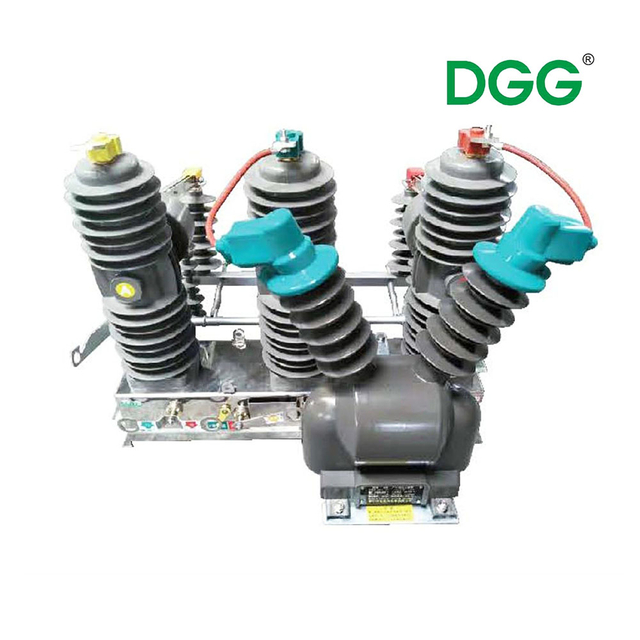
As distribution networks continue to adopt automation technologies, the reliable operation of a pole-mounted circuit breaker depends on more than the mechanical performance of the breaker itself. The primary switching unit, current and voltage sensing devices, protection controller, operating circuit, status feedback and communication system must work as a coordinated whole.
DGG Power recently provided practical training and commissioning support for primary and secondary integrated pole-mounted circuit breakers at a power utility training facility. Multiple circuit breakers were arranged in a controlled training environment so that utility personnel could carry out switching operations, trip verification, protection checks and signal coordination under standardized conditions.
The purpose of the program was not simply to demonstrate that the circuit breakers could open and close. It was designed to help technical personnel understand how a protection command is generated, how the primary equipment responds, how the operating status is returned to the controller, and how abnormal conditions should be traced across the complete primary-secondary system.
Item
Details
Project type
Power utility technical training and commissioning
Main equipment
Primary and secondary integrated pole-mounted circuit breaker
Application
Distribution feeder protection and distribution automation
Core work
Switching operation, trip verification, protection logic, signal feedback and primary-secondary coordination
Training value
Standardized commissioning, improved troubleshooting and stronger practical operation capability
DGG Power support
Equipment support, technical explanation, commissioning assistance and operational guidance
Why Primary-Secondary Coordination Matters
A primary and secondary integrated pole-mounted circuit breaker combines the physical switching capability of the primary equipment with the sensing, protection and control functions of the secondary system.
The primary section carries current, opens and closes the feeder and interrupts fault current. The secondary section receives current or voltage signals, evaluates the operating condition according to protection settings and sends commands to the breaker mechanism.
These two sections must operate as one system.
A circuit breaker may complete a mechanical opening operation correctly, but the overall system can still fail to meet project requirements if the controller settings are incorrect, the auxiliary contacts return the wrong status, or the trip circuit is not properly connected. Likewise, a controller may correctly identify a fault, but the protection chain is incomplete if the operating mechanism does not execute the command reliably.
This is why commissioning cannot stop at checking whether the breaker moves. The complete process—from signal acquisition to protection judgment, command output, mechanical action and status feedback—must be verified as a closed loop.
From a Trip Command to a Complete Operating Loop
During a protection operation, the controller first receives electrical signals from the sensing devices. It then compares those signals with the configured protection settings. If the operating condition meets the trip criteria, the controller sends a command to the breaker.
The operating mechanism converts that electrical command into mechanical movement. The moving contact separates, and the vacuum interrupter interrupts the current. After the operation is completed, auxiliary contacts and position indicators return the breaker status to the controller or monitoring system.
For technical personnel, understanding this sequence is essential. It makes it easier to distinguish whether an abnormal condition comes from the primary equipment, the controller logic, the operating circuit, the signal wiring or the communication interface.
Practical training turns this process from an abstract diagram into a visible and repeatable operating chain. Technicians can observe the equipment response, compare controller indications with the actual breaker position and learn how to trace a problem step by step.
Switching Operation and Mechanical Response
The first stage of practical training usually focuses on the basic operating condition of the breaker. Technical personnel carry out local opening and closing operations and confirm whether the mechanism responds smoothly and consistently.
The purpose is not simply to repeat the operation several times. Personnel need to understand the relationship between the operating command, mechanism movement, mechanical position indication and auxiliary contact feedback.
If the breaker reaches the correct mechanical position but the controller receives the wrong signal, the problem may lie in the auxiliary contact or secondary wiring. If the controller sends the correct command but the breaker does not complete the operation, attention should shift to the operating power supply, trip or closing circuit and mechanical mechanism.
This way of thinking is more useful than memorizing individual test items because it helps personnel establish a practical troubleshooting method.
Protection Verification and Fault Simulation
Protection verification helps personnel understand how the secondary controller responds to abnormal electrical conditions and how the primary breaker executes the protection command.
According to the equipment configuration and training plan, the commissioning process may include overcurrent action, trip-command verification, operating-time observation, automatic reclosing checks and lockout logic verification.
The key point is not to create a fault for demonstration. It is to confirm whether the protection setting, controller judgment, trip output, mechanism response and event record remain consistent throughout the test.
When the operating result does not match the expected logic, technicians must determine whether the deviation comes from the protection setting, input signal, trip circuit, mechanism condition or reset procedure. This structured analysis is one of the most valuable parts of practical training.
Status Feedback and Distribution Automation
Distribution automation depends on accurate field information. A remote control platform cannot make a reliable judgment if the breaker status, protection signal or operating mode returned from the field is incorrect.
During commissioning, the actual mechanical position of the breaker should be compared with the information received by the controller. Local and remote operating modes must also be clearly distinguished to prevent conflicting commands.
Where communication functions are configured, technicians may further verify whether operating status, fault information and event records can be transmitted correctly to the associated control system.
For a power utility, accurate status feedback is not a secondary detail. It affects remote operation, fault location, feeder sectionalizing and restoration decisions. A small signal error may eventually become a larger operation and maintenance problem.
Why a Controlled Training Environment Is Valuable
Testing intelligent distribution equipment directly in an operating network is subject to strict safety and operating restrictions. A controlled training environment allows technical personnel to repeat operations, compare different equipment states and analyze abnormal conditions without affecting an active feeder.
Clearly divided training zones, equipment labels, circuit identification and standardized operating procedures also help create a more consistent learning process. Personnel can focus on the logic of the equipment instead of dealing with the uncertainty of a live project site.
Multiple units arranged in the same training area also make it possible to conduct comparative exercises. Different groups can follow the same procedure, record the results and identify whether deviations come from equipment configuration or operating methods.
This improves not only individual understanding, but also the consistency of the entire commissioning and acceptance team.
The Practical Value for Power Utilities
For power utilities, technical training is not an optional activity added after equipment delivery. It is an important step in turning equipment functions into reliable field operation.
Primary and secondary integrated pole-mounted circuit breakers combine mechanical switching, sensing, protection, control and communication functions. If operation and maintenance personnel understand only the breaker body but are unfamiliar with controller logic or signal feedback, problems may still arise during acceptance, operation or fault analysis.
Practical training allows personnel to complete switching operations, protection verification and signal checks in a controlled environment. Through repeated operation and fault simulation, they can better understand how the primary equipment responds to secondary commands, how protection actions are recorded and how abnormal conditions should be investigated.
This experience helps improve commissioning consistency, strengthens cooperation between operation, maintenance and automation teams, and provides a clearer technical basis for later equipment acceptance and maintenance.
Equipment quality provides the foundation. Standardized commissioning and skilled operation help turn that capability into reliable grid performance.
DGG Power’s Technical Service Beyond Equipment Delivery
For intelligent distribution equipment, delivery is not the end of the project. The breaker body, sensing configuration, controller functions, wiring, protection settings and communication requirements must be correctly connected with the customer’s application.
DGG Power supports customers according to the actual project configuration. Technical service may include equipment-function explanation, primary and secondary wiring coordination, controller-operation guidance, protection-action verification, automatic reclosing checks and commissioning communication.
The purpose of this service is not to replace the utility’s operating procedures or system design. It is to help customers understand the supplied equipment, reduce information gaps during commissioning and connect product functions with actual field requirements.
As a supplier of medium- and high-voltage transmission and distribution equipment, DGG Power continues to strengthen both product capability and project-based technical support for utilities, EPC contractors and distribution network operators.
FAQ
What is the purpose of primary and secondary integrated circuit breaker training?
The purpose is to help technical personnel understand the complete relationship between breaker operation, protection logic, operating circuits, status feedback and distribution automation—not only the mechanical opening and closing of the breaker.
What should be verified during commissioning?
Commissioning should verify the complete operating chain, including signal acquisition, controller judgment, trip and closing circuits, mechanism response, mechanical position, auxiliary contact feedback and communication functions where configured.
Does every integrated pole-mounted circuit breaker include automatic reclosing?
Not necessarily. Automatic reclosing depends on the controller, sensing devices, auxiliary power, operating mechanism and protection strategy specified for the project.
Why is practical training necessary if the equipment has already passed factory tests?
Factory tests verify product performance under specified conditions. Practical training helps utility personnel understand the delivered configuration, operating logic and commissioning process required for later acceptance, operation and maintenance.
Can DGG Power provide training and commissioning support?
DGG Power can provide project-based technical support according to the breaker configuration, controller functions, protection requirements and application environment.
Conclusion
Primary and secondary integrated pole-mounted circuit breakers connect physical switching equipment with protection, control, monitoring and distribution automation. Reliable operation depends not only on manufacturing quality, but also on correct configuration, complete commissioning and a clear understanding of the operating logic.
Through this practical training and commissioning service, DGG Power supported power utility personnel in verifying the complete operating chain and strengthening their understanding of primary-secondary coordination.
For primary and secondary integrated pole-mounted circuit breakers, feeder automation equipment or related technical support, contact DGG Power with your system voltage, protection requirements, controller configuration, communication needs and project specifications.