Root Cause Analysis of a 35kV Vacuum Circuit Breaker Power Frequency Withstand Failur
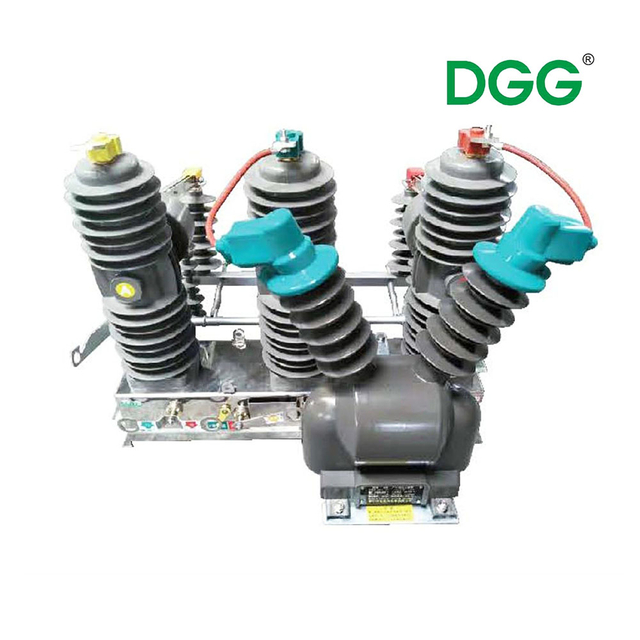
In November 2025, a cooperating customer reported an insulation breakdown issue during a routine power frequency withstand test on a ZW32-40.5 vacuum circuit breaker. After receiving the feedback, the DGG Power technical team arrived on-site to verify the situation and later conducted a full root-cause investigation after the equipment was returned to our factory.
This article summarizes the failure mechanism, diagnostic findings, corrective actions, and validation tests performed to ensure long-term product reliability.
1. Background of the Incident
The affected breaker (Serial No. 25090009) was manufactured in October 2025. On November 5, the customer performed a power frequency withstand test on the A-phase interrupter. During the test, the A-phase failed at the vacuum gap.
To verify phase consistency, our on-site engineer performed dielectric tests on the B-phase and C-phase interrupters in the customer’s test facility:
C-phase successfully passed the 1-minute withstand test at 95 kV
B-phase tripped the test equipment at 92.89 kV, and tripped again at 27.92 kV during re-application of voltage, indicating a complete breakdown of the vacuum insulation path
These results suggested that more than one phase might have suffered insulation degradation, requiring return-to-factory analysis.
2. Failure Analysis After Disassembly
Once the breaker was returned on November 21, our engineering team performed a complete teardown. Contrary to early assumptions, the breakdown did not occur inside the vacuum interrupter gap.
Actual breakdown location:
The failure occurred at the resin-filled interface between the vacuum interrupter and the epoxy insulating housing, as shown in the inspection images.
The breaker involved was a prototype for an “enhanced external insulation” design. Resin encapsulation was added around the vacuum interrupter to reduce the risk of surface creepage in high-altitude regions.
However, the analysis found:
Air bubbles were present inside the potting compound
Under power frequency overvoltage, electric field concentration formed around the voids
Repeated withstand tests caused partial discharge, leading to tree-shaped micro-cracks
Progressive deterioration resulted in external insulation breakdown
To confirm whether the same mechanism affected the A-phase, the vacuum interrupter was removed and inspected. The result matched the B-phase failure: breakdown occurred in the resin-filled interface, not inside the vacuum gap.
3. Corrective Actions Implemented by DGG Power
To ensure long-term reliability and prevent recurrence, the following measures have been implemented:
The affected breaker has been reassembled and fully replaced for the customer.
Future products will no longer include the additional resin encapsulation process.
A new generation of fully solid-insulated poles is now under development, following optimized casting processes and void-elimination techniques to strengthen long-term dielectric performance.
These actions enhance product consistency and improve insulation reliability across various operating environments.
4. Withstand Test Verification After Reassembly
After corrective work, the breaker underwent repeated power frequency withstand tests using three independent testing platforms to ensure the validity of results:
a) DGG Power Switchgear Workshop – dielectric withstand test passed b) DGG Power Instrument Transformer Division – dielectric withstand test passed c) Third-party high-voltage electrical equipment manufacturer – dielectric withstand test passed
All tests confirmed that the breaker met and exceeded the required insulation performance levels.
Conclusion
This incident highlights the importance of strict control in solid-insulation manufacturing, especially in resin-potting processes used in medium-voltage vacuum switchgear. While the failure was confined to a prototype structure, the lessons learned have contributed directly to DGG Power’s continued optimization of insulation systems and product reliability.
By enhancing process standards and accelerating the development of improved solid-insulated pole designs, DGG Power remains committed to delivering safe, durable, and high-performance 11–123kV power distribution equipment for utilities, industrial users, and EPC contractors worldwide.
If you enjoyed this article and would like to explore more technical content, case studies, and updates from DGG Power, feel free to follow us on our social media platforms. We love connecting with engineers, partners, and industry professionals around the world.
Your follow and support truly mean a lot to us—it motivates us to keep sharing valuable knowledge and building even more reliable products.